Nutrition now has become an increasingly crucial part of conversations around health, disease prevention as well as long-term well-being. As more people look far beyond conventional dietary advice, the need for the professionals who truly understand nutrition science and its practical applications continues to grow. This has also made nutrition a very popular career choice for students, healthcare professionals and people looking to transition into the wellness landscape.
However, finding the best nutrition courses in India can be quite challenging. There are certificate programmes, diplomas, postgraduate courses and specialized certifications, each of them offers a very different learning experience. Some of these focus on foundational nutrition, while others explore clinical practice, functional nutrition along with health coaching.
This blog compares 5 different nutrition programmes to help you understand their curriculum, learning formats, fees and duration, so you can make much more informed decisions.
Best Nutrition Courses in India at a Glance
If you are exploring the best nutrition courses, comparing programmes side by side is a useful starting point. Course names alone do not tell you much about the depth of training, practical exposure or support you can expect. Looking at the nutrition courses details, including curriculum, teaching format, fees and duration, can help you identify the right fit.
Here is a quick overview of five programmes available in India.
| Programme | Course type | Learning format | Duration | Fee |
|---|---|---|---|---|
| iThrive Academy - Integrative Certification in Functional Nutrition (ICFN) | Functional nutrition certification | Live online classes, assessments, casework and mentorship | 6 months | Talk to a counsellor. |
| NFNA - Diploma in Applied Nutrition, Food Science & Dietetics | Diploma | Live and recorded learning, assignments and assessment | 6 months | ₹70,000 |
| Nufit Redefined - Diploma in Nutrition and Dietetics | Diploma | Online learning with practical learning opportunities | 3 months | ₹60,000 |
| NIND - PG Diploma in Holistic Nutrition & Wellness | Postgraduate diploma | Self-paced or 1:1 live online mentorship | 1 year | ₹25,999 / ₹36,999 |
| VitaOne - Advanced Certificate Program in Functional Medicine & Clinical Nutrition (FMCN) | Advanced certificate | Online learning and live case reviews | 6 months | 35,000 |
These programmes serve different learning needs. ICFN and VitaOne completely focus on functional as well as clinical nutrition, while NFNA and Nufit offer broader nutrition and dietetics training. On the other hand, NIND provides a holistic nutrition programme with two learning formats.
The right choice depends on your existing knowledge, professional goals and the level of practical training you want from a course.
What Should You Look for in a Nutrition Course?
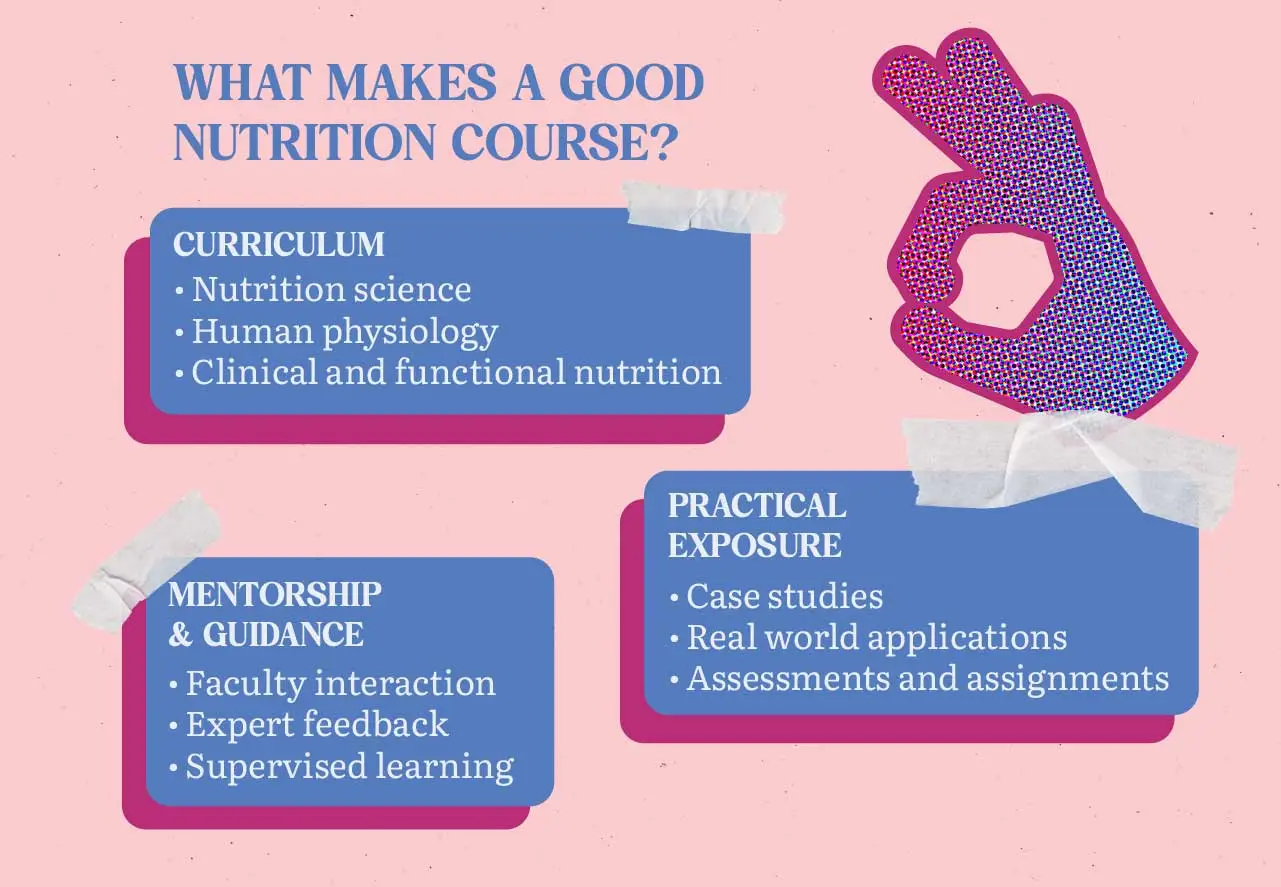
Choosing a right nutrition course includes much more than just comparing the fees and selecting a programme with an over appealing certificate. The quality of the curriculum, approach of teaching, and the practical exposure can have a major influence on what you take away from the entire experience.
If you are comparing the best nutrition course in India, consider all of the below factors before enrolling.
1. Curriculum and Subject Coverage
Always start by reviewing the syllabus entirely. A good programme should always cover the fundamentals of nutrition, involving macronutrients, micronutrients, digestion, metabolism as well as dietary planning. If you are interested in clinical or functional nutrition, look for subjects like nutritional biochemistry, hormonal health, inflammation, gut health, and metabolic function.
2. Practical Learning Opportunities
Nutrition is an applied field. So understanding how nutrients work in the body is important, but so is learning how to utilize that knowledge in real-world situations. Check whether the programme includes case studies, assignments, client scenarios, supervised practice or opportunities to interpret health information.
3. Faculty and Mentorship
Look into the qualifications of the faculty and professional experience. Learning from practising nutritionists, dietitians, doctors and other healthcare professionals can honestly provide valuable insights. Also do consider whether the course offers key opportunities to ask random questions, receive feedback, and discuss real-life cases.
4. Learning Format and Flexibility
Some nutrition certificate courses are entirely self-paced, while others offer live online classes, recorded sessions or one-on-one mentorship. Choose the best format that fits your schedule and preferred way of learning. If you benefit from interaction and discussion, a programme with live sessions will prove to be more suitable.
5. Certification and Recognition
Understand who issues the certificate, what the qualification represents and whether the programme has any affiliations, recognition, or not. A private certification or diploma should not automatically be considered equivalent to a university degree or a regulated professional qualification. Always check the eligibility requirements for the career path you want to pursue.
6. Fees, Duration and Student Support
Compare the course fee with its duration, hours of teaching, assessments, learning resources and mentorship. A lower-cost course can still be appropriate for foundational learning, while a more intensive programme will surely offer clinical casework and additional guidance. Find out what support is available during the course and after graduation.
Ultimately, the right course should give you a clear understanding of what you will learn, how you will learn it and how that knowledge can support your next step.
Nutrition Certificates, Diplomas, and Degrees Compared
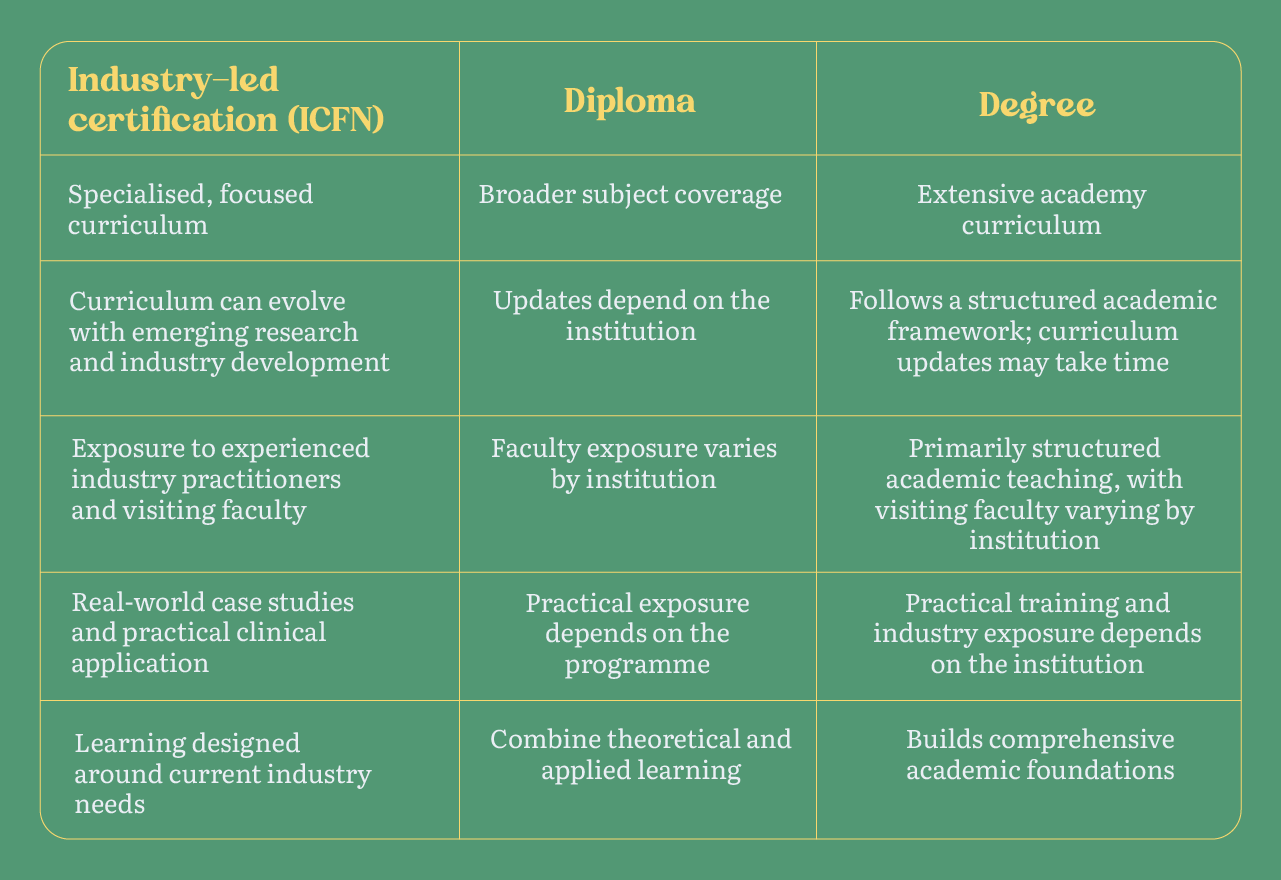
Understanding these differences can drastically help you in choosing a programme that matches your educational background and career plans.
Nutrition Courses Certificate
A certificate course generally provides focused learning in a specific subject or an introduction to a broader field. It covers certain topics such as sports nutrition, weight management, gut health, dietary planning or even functional nutrition.
These programmes are mostly very shorter than diplomas and can just be useful for people who want to develop a specific skill or build foundational knowledge. They might also suit healthcare and wellness professionals looking to expand their understanding of nutrition.
However, the depth of learning and recognition of a certificate is entirely dependent on the issuing institution and the structure of the course.
Nutrition Courses Diploma
Diploma programmes usually offer a structured coverage of nutrition-related subjects. Depending on the provider, the curriculum may include nutrition science, food science, dietetics, meal planning, clinical nutrition and practical assignments.
A diploma can be very suitable for learners looking out for broader subject knowledge. Some programmes also include internships, case studies or practical exercises that help in connecting classroom learning with real-world applications as well.
Before enrolling, check the entry requirements of the course, duration, assessment structure and the qualification awarded.
Nutrition Courses Degree
Degree programmes, such as a bachelor’s or master’s degree in nutrition and dietetics, follow a formal academic curriculum. They typically involve more extensive study of human physiology, biochemistry, nutrition science, food science and dietetics.
Depending on the institution, students may also complete laboratory work, internships or supervised practical training.
A degree may be important for certain academic and professional pathways, particularly where specific qualifications are required. If you are considering a clinical role, check the relevant eligibility and registration requirements rather than assuming that every nutrition qualification offers the same professional scope.
General, Clinical and Functional Nutrition Courses Explained
Nutrition is a broad field, and different programmes approach it from different perspectives. Before choosing a course, it helps to understand what general, clinical and functional nutrition involves.
General Nutrition Courses
General nutrition courses introduce the relationship between food, nutrients and human health. They usually cover macronutrients, micronutrients, digestion, energy balance, dietary guidelines and meal planning.
These courses can be a good initial point for beginners who want to understand how food choices influence the body. Depending on the programme, learners might also want to explore weight management, food science and nutrition, along with sports nutrition across various stages of life.
Clinical Nutrition Courses
Clinical nutrition emphasises on the role of nutrition in health conditions and their management. Topics might include medical nutrition therapy, nutritional needs across various life stages, therapeutic diets, and disease-specific dietary planning.
These programmes are highly relevant to learners interested in healthcare settings or those who already have a background in nutrition, dietetics or allied health sciences. Case studies and practical assignments can help learners understand how nutritional requirements may differ from one individual to another.
Functional Nutrition Courses
Functional nutrition takes a broader, individualised approach to understanding health. It explores how nutrition, lifestyle, health history, symptoms and relevant clinical investigations may connect.
Depending on the curriculum, learners may study nutritional biochemistry, gut health, hormonal health, inflammation, metabolic function and functional blood chemistry. The approach encourages learners to understand the interconnected systems that influence health rather than viewing every concern in isolation.
For those interested in this approach, the Integrative Certification in Functional Nutrition (ICFN) by iThrive Academy offers a specialised learning pathway that combines foundational nutrition concepts with clinical learning, functional blood chemistry, interpretation of 55+ biomarkers and supervised casework. iThrive Academy and Research Centre was also recognised as Company of the Year – Wellness and Functional Nutrition Education 2026 by SiliconIndia, reflecting its contribution to functional nutrition education in India.
Top 5 Nutrition Certifications and Diploma Programmes Compared
The following 5 programmes provide various approaches to nutrition education. Some focus on foundational nutrition and dietetics, while others explore functional and clinical nutrition in greater depth.
1. iThrive Academy – Integrative Certification in Functional Nutrition (ICFN)
- Course type: Functional nutrition certification
- Duration: 6 months
- Fee: Talk to a counsellor
- Learning format: Live online classes, assessments, casework and mentorship
- Official website: https://www.ithrive.academy/icfn
The Integrative Certification in Functional Nutrition (ICFN) by iThrive Academy is a 6 month programme that is specifically designed for learners who want to develop a deeper understanding of nutrition through a functional health lens.
Unlike other courses that focus significantly on dietary planning and foundational nutrition concepts, ICFN explores how different systems in the body interact with each other and how nutrition and lifestyle factors might have an influence on health. The programme combines foundational learning with clinical concepts, functional blood chemistry and supervised casework.
What Does the Programme Cover?
The curriculum includes:
- Human physiology and the foundations of functional nutrition.
- Functional nutrients, dietary supplements and metabolic pathways.
- Functional blood chemistry and the interpretation of 55+ biomarkers.
- Gut health, digestive function and introductory GI Map concepts.
- Endocrine, cardiovascular, neurological and autoimmune health concerns.
- The gut-brain connection, stress physiology and mental health.
- Functional nutrition interventions and individualised approaches.
- Detoxification, environmental influences and functional movement.
The programme is structured across a two-week foundation gateway, a 4.5-month clinical core and a final month of supervised group casework. It includes approximately 105 live teaching hours through online sessions, along with assessments, case discussions, Q&A sessions and feedback.
What Makes ICFN Different?
One of the key aspects of ICFN is its emphasis on applying concepts rather than learning them in isolation. Learners engage with clinical scenarios, case walkthroughs and assessments designed to help them understand how different health markers and physiological systems may relate to one another.
The programme is led by practising professionals and draws on iThrive’s clinical experience. Its learning structure is designed to help learners develop a more connected understanding of health, nutrition and individual variation.
The programme also includes supervised casework and mentorship, offering learners an opportunity to engage with clinical reasoning and receive feedback as they progress.
Who Should Consider ICFN?
ICFN might be worth exploring if you are a nutritionist, dietitian, healthcare professional or a wellness practitioner looking to deepen your understanding of functional nutrition. It might also appeal to learners who want to move far beyond basic dietary advice and explore the relationship amongst nutrition, biomarkers, lifestyle as well as health concerns.
Prospective students are also welcomed as there is a foundation gateway which will help learners get the terms and the basics clear.
2. NFNA – Diploma in Applied Nutrition, Food Science & Dietetics
- Course type: Diploma
- Fee: ₹70,000
- Learning format: Live as well as recorded classes.
- Official website: https://www.nfna.in
The National Fitness and Nutrition Academy (NFNA) offers programmes in applied nutrition, food science and dietetics. Its Diploma in Applied Nutrition, Food Science & Dietetics is designed to provide structured learning across a few areas of nutrition and food science.
The programme includes more than 100 hours of learning, with live and recorded classes, assignments and the final examination. The curriculum is quite relevant to learners interested in understanding the fundamentals of nutrition and their applications in dietetics and wellness.
Who Should Consider It?
This programme might suit learners who want just nutrition and dietetics education through a combination of live and recorded learning.
3. Nufit Redefined – Diploma in Nutrition and Dietetics
- Course type: Diploma
- Fee: ₹60,000
- Learning format: Online learning
- Official website: https://nufitredefined.in/
Nufit Redefined provides nutrition education via diploma programmes and specialised courses. Its Diploma in Nutrition and Dietetics covers a wide range of subjects that are relevant to nutrition practice, including diet planning, weight management, clinical nutrition as well as sports nutrition.
The programme is completely intended to help learners develop an understanding of nutrition concepts and their application across different health and wellness needs. The provider also lists practical learning opportunities and internships among its offerings.
Who Should Consider It?
Nufit can be worth considering if you are looking for a broader introduction to nutrition and dietetics, with exposure to different areas of practice.
4. NIND – PG Diploma in Holistic Nutrition & Wellness
- Course type: Postgraduate diploma
- Duration: 1 year
- Fee: ₹25,999 for self-paced learning / ₹36,999 with 1:1 live online mentorship
- Learning format: Self-paced or live online mentorship
- Official website: https://nindofficial.org/
The Navast Institute of Nutrition and Dietetics (NIND) provides programmes across nutrition, dietetics and wellness. Its PG Diploma in Holistic Nutrition & Wellness is a one-year programme that is specifically designed to explore nutrition through a broader wellness perspective.
Learners can choose between 2 formats. The self-paced option is priced at ₹25,999, while the option that includes one-on-one live online mentorship with a coach mentor costs ₹36,999.
Who Should Consider It?
NIND might suit learners interested in holistic nutrition who want the flexibility to choose between independent study and a programme with individual mentorship.
5. VitaOne – Advanced Certificate Program in Functional Medicine & Clinical Nutrition (FMCN)
- Course type: Advanced certificate
- Duration: 6 months
- Fee: ₹35,000
- Learning format: Online learning
- Official website: https://education.vitaone.in/
VitaOne Education offers the Advanced Certificate Program in Functional Medicine & Clinical Nutrition (FMCN), a six-month online programme focused on functional medicine and clinical nutrition.
The programme covers subjects such as biomarker interpretation, the gut-brain-immune connection, thyroid health, insulin resistance and supplementation. Its learning resources include more than 10 modules, 10+ tools and 12+ live case sessions.
Who Should Consider It?
VitaOne may be relevant to learners who want an introduction to functional medicine and clinical nutrition through an online programme.
When Should You Consider ICFN?
If your interest goes beyond foundational nutrition and you want to understand how various systems in the body influence health, a specialised functional nutrition programme might be worth considering.
ICFN may be particularly relevant if you:
- Already have a background in nutrition, dietetics, healthcare or wellness and want to deepen your knowledge.
- I want to enter the functional nutrition landscape, without even any specific background but yes of course have a keen interest in learning.
- I want to understand functional blood chemistry and the interpretation of 55+ biomarkers.
- Are interested in gut health, hormonal health, metabolic function and other interconnected areas of physiology.
- Prefer live learning, case discussions and feedback over relying entirely on self-paced study.
- Want supervised casework and mentorship as part of your learning experience.
The six-month ICFN programme combines foundational learning, live clinical teaching and supervised casework. It is a more intensive investment than some of the shorter or self-paced programmes in this comparison.
However, the decision should clearly not be based on the fee alone. Consider whether the curriculum, teaching format and practical exposure align with the kind of nutrition professional you want to become.
You can explore the programme structure and eligibility details on the **iThrive Academy ICFN page**.
Nutrition Course Type and Duration: What Should You Expect?
One of the most common questions learners have is what type of nutrition course is and how long it takes to complete. The answer depends on the type of qualification, depth of the curriculum, teaching format along with the support offered.
As the comparison shows, nutrition courses can range from focused learning programmes to considerably more intensive certifications and diplomas.
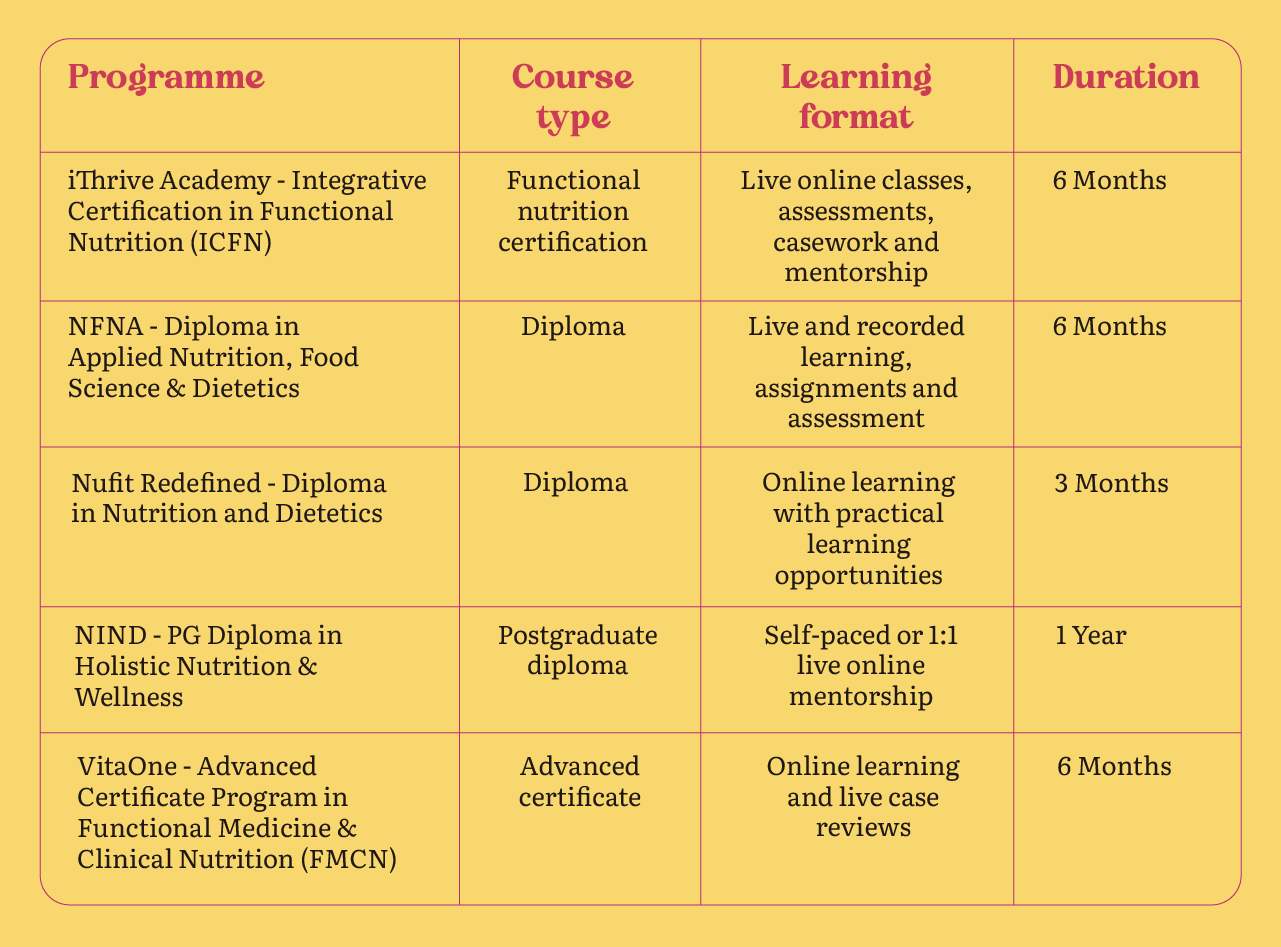
The nutrition courses duration also varies. A focused certificate may take a few weeks or months, while a diploma or postgraduate programme may extend over a year or longer. Some programmes provide flexible, self-paced learning, whereas others follow a fixed schedule of live lectures and assessments.
Some of the programmes offer flexible, self-paced learning, whereas some follow a fixed schedule of live assessments and lectures.
When comparing the type of the course,always look at what the course includes. Consider the number of teaching hours, access to faculty, assessments, case studies, mentorship, and learning resources.
Career Opportunities After Completing a Nutrition Course
Nutrition education can open up different learning and career pathways, depending on your qualifications, experience and professional eligibility. Before choosing a programme, it helps to understand the roles you may want to pursue and the additional requirements associated with them.
Is Being a Nutritionist a Good Career in India?
Nutrition is definitely a rewarding career for people interested in food, health and human physiology. Growing awareness of lifestyle-related health concerns has developed key opportunities across wellness centres, fitness organisations, healthcare settings, nutrition brands, education and private practice.
However, career opportunities depend on your qualifications, practical experience and area of specialisation. Roles involving clinical dietetics or regulated healthcare practice also require specific academic qualifications and supervised training. A short private certification should not be assumed to provide the same eligibility as a recognised degree.
How to Become a Wellness Coach?
A wellness coach generally helps the individuals work towards lifestyle-related goals through guidance on areas such as nutrition habits, physical activity, sleep and stress management.
If you're exploring how to become a wellness coach, start by building a better understanding of health and nutrition fundamentals. You can then pursue relevant training in communication, wellness coaching as well as behaviour change.
How to Become a Nutrition Coach?
If you're interested in how to become a nutrition coach, always begin by understanding the educational requirements for the kind of work you want to do. A relevant qualification in dietetics, nutrition, or an allied field can offer a stronger foundation.
You may then build additional skills through specialised courses, practical learning and mentorship. Nutrition coaches should work within their training and professional scope, particularly when supporting individuals with diagnosed health conditions.
How Much Does a Nutritionist Earn in India?
A nutritionist’s earnings in India vary depending on qualifications, experience, location, work setting and specialisation. Professionals may work in hospitals, clinics, fitness centres, wellness organisations, food and supplement companies or private practice.
There is no single salary figure that applies to everyone. Entry-level roles, experienced practitioners and independent consultants may have very different earning structures.
Conclusion
The best nutrition course isn't necessarily the most expensive or with the longest syllabus. It's the programme that matches your learning preferences, background, as well as professional goals.
Whether you are considering a certificate, diploma or advanced functional nutrition programme, always ensure to compare the curriculum, faculty, practical exposure, mentorship, fees along with the duration before making a decision.
Also, if you want to explore functional nutrition in greater depth, the six-month ICFN programme by iThrive Academy offers a well structured combination of live clinical learning, biomarker interpretation and supervised casework.
Explore the iThrive Academy ICFN programme to understand the curriculum, learning structure and eligibility requirements.