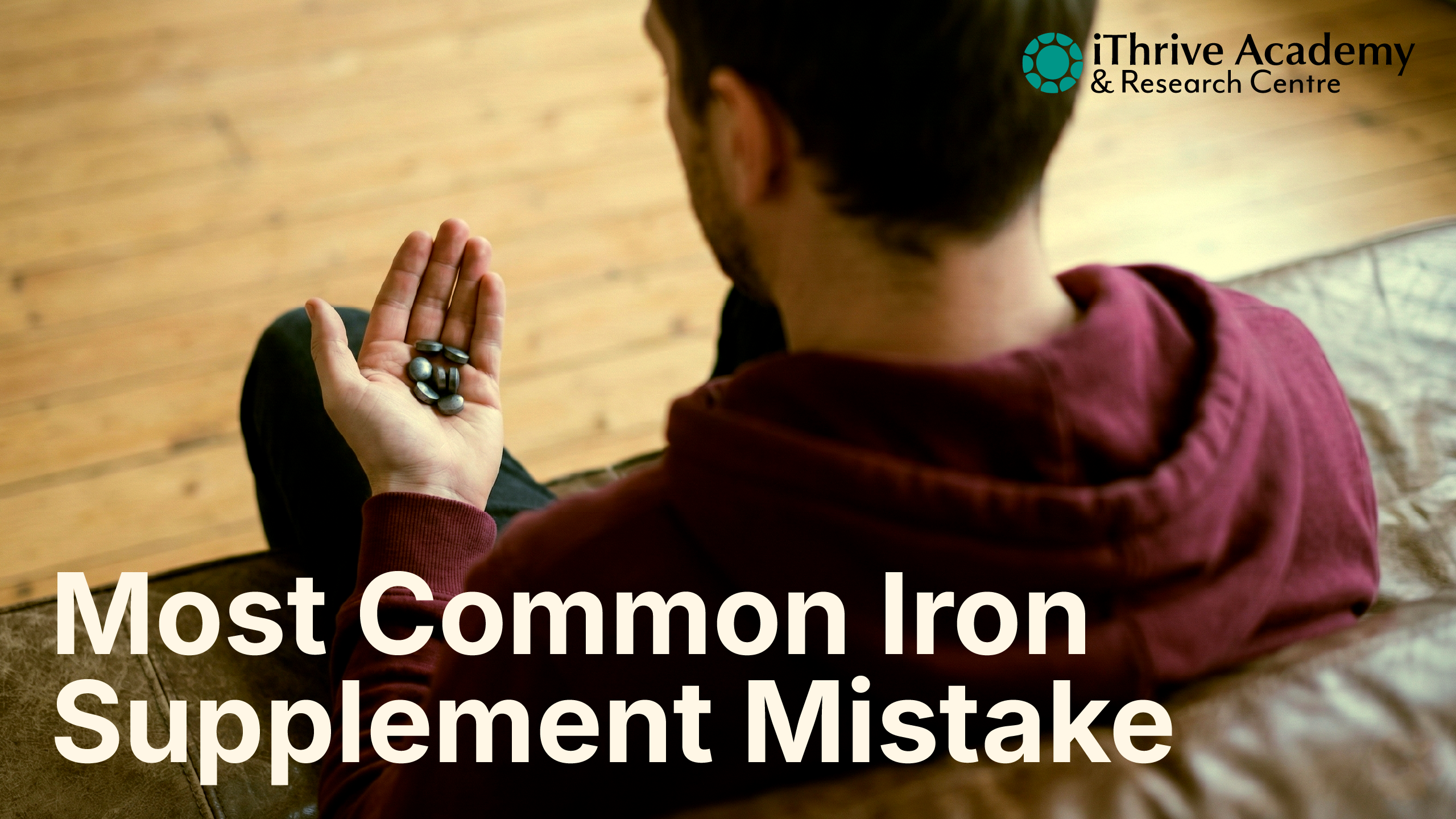
Walk into any pharmacy and you will find shelves filled with iron supplements. They are marketed as quick fixes for fatigue, hair fall, pale skin, dizziness, and poor concentration. For many people grappling with these symptoms, iron seems like the obvious answer.
But here is the truth that very few people know.
Taking iron without understanding your labs is one of the most dangerous supplement mistakes you can make. Iron is essential for oxygen transport, energy production, thyroid activation, and overall metabolic health. However, when taken blindly, it becomes a biological stressor that triggers oxidative damage, increases infection risk, and worsens metabolic dysfunction. This is exactly why at iThrive Academy, the first academy in India to teach functional nutrition, we emphasise a root cause approach in all our programs, including the Iron Dysregulation Short Course, which trains learners to decode iron markers deeply and accurately.
Before exploring why blindly taking iron is harmful, we need to understand something fundamental.
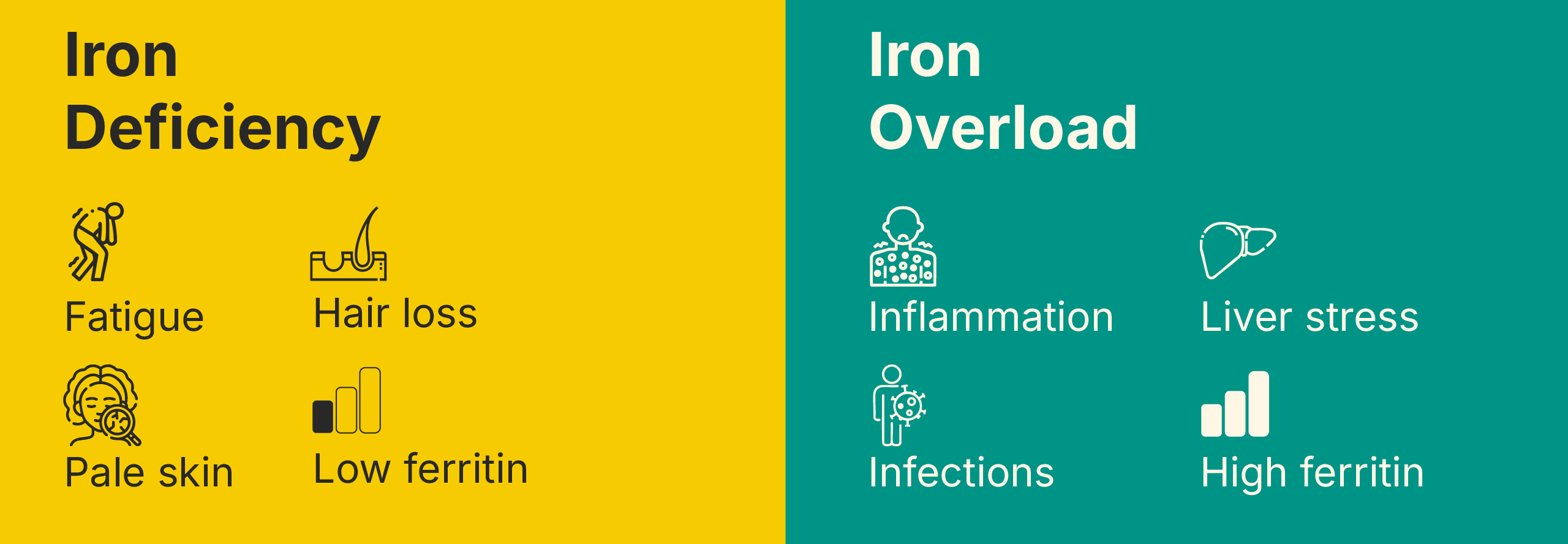
Iron deficiency and iron overload can present with very similar symptoms.
If you do not know your iron homeostasis, supplementing can push the body into deeper imbalance.
Where People Go Wrong With Iron Supplements
Iron Dysregulation Is More Common Than Iron Deficiency
Most individuals assume that their tiredness or hair thinning automatically means low iron. But in functional medicine, we often see the opposite. Many people have normal or low serum iron but extremely high ferritin or low Iron Binding Capacity This is not a deficiency. It is an iron overload.
When someone in this state takes iron supplements, their symptoms worsen. They experience inflammation, oxidative stress, infections, and hormonal disruption.
This challenge is at the core of what we teach in the iCFN Course, where learners are guided to understand iron metabolism, root cause analysis, nutrient interactions, and functional biomarkers that standard testing often overlooks.
The Danger Of Looking Only At Serum Iron
Serum iron is one of the most misleading markers in laboratory testing. It fluctuates daily and reacts to food, stress, and infections. A person may show low serum iron on paper but have extremely high ferritin, low TIBC, or elevated hepcidin levels. This is why we teach our students that serum iron is never enough. It is only one chapter in a very large story.
To understand functional iron balance, you need a complete picture of iron regulation.
The Real Risks Of Blind Iron Supplementation
Iron Toxicity And Organ Stress
Excessive iron acts like a spark in a room full of fuel. Too much iron accumulates in organs, especially the brain and liver. Over time, this leads to cellular injury, metabolic sluggishness, cognitive dysfunction, and liver strain. Early signs include nausea, stomach pain, vomiting, and headaches, but the long term impact is far more damaging.
Higher Susceptibility To Infections
Iron is the favourite nutrient of most bacteria and viruses. When you increase iron in the bloodstream without checking whether your body needs it, you unknowingly feed pathogens. Individuals with iron overload are more prone to repeated infections, slow healing, and greater immune burden.
Oxidative Stress And Metabolic Slowdown
Iron acts as a catalyst in oxidative reactions. When combined with high polyunsaturated fatty acids and poor antioxidant reserves, iron overload becomes a driver of deep oxidative stress. This results in fatigue, inflammation, thyroid dysfunction, and a suppressed metabolic rate.
Understanding Iron Homeostasis The Right Way

Why A Comprehensive Iron Panel Is Non Negotiable
To understand whether you truly need iron, a larger panel is essential. Inside the Iron Regulation Course at iThrive Academy, students learn how to interpret:
- Ferritin
- Total Iron Binding Capacity
- Transferrin saturation
- Serum iron
- Hepcidin
- Inflammatory markers
- Full blood examination including MCV, RDW, and RBC indices
These markers together reveal iron storage, transport, availability, and utilisation.
Ferritin Is The Most Important Indicator
Ferritin tells us how much iron is stored in the body. Optimal levels are generally considered between 50 and 125 nanograms per millilitre. Low ferritin often coexists with low thyroid function. High ferritin often represents chronic inflammation or iron overload, not healthy iron reserves. This distinction is trained in depth at iThrive Academy’s Iron Dysregulation Short Course, preparing learners to understand functional patterns rather than surface numbers.
The Link Between Iron And Thyroid Function
Iron is a cofactor for Thyroid Peroxidase, which is necessary for T3 and T4 production.
Low iron and low ferritin often appear in:
- Hypothyroidism
- Hashimoto’s
- Subclinical thyroid dysfunction
This is why many individuals with thyroid symptoms mistakenly assume they need more iron. But unless tested correctly, supplementation can worsen inflammation and immune dysregulation.
In the iCFN Course, students learn how iron balance shapes hormonal function and why thyroid physiology cannot be assessed without evaluating iron markers.
Nutrient Interactions And Synergistic Deficiencies
Iron does not operate alone. It interacts with zinc, copper, vitamin B12, protein intake, and even food based compounds like tannins.
- High zinc intake can decrease iron absorption.
- Excessive iron can decrease copper availability.
- Plant based diets often reduce iron bioavailability.
These complexities show why iron metabolism cannot be managed through single marker testing or guesswork.
When More Iron Is Actually The Wrong Answer

Iron supplementation sounds straightforward, but it is deeply intertwined with metabolic signalling, inflammation, thyroid activation, and cellular energy.
The body regulates iron through a hormone called hepcidin, which increases during infection, inflammation, and metabolic stress. When hepcidin is high, iron is trapped inside cells and cannot be utilised.
Supplementing iron at this stage only increases oxidative stress while doing nothing to fix the underlying block.
This is iron dysregulation, not true deficiency.
And this is exactly why the Iron Dysregulation Short Course exists.
Learners gain the scientific confidence to decode why a person is tired, anemic, or inflamed, without defaulting to supplements.
Why Functional Nutrition Is Essential For Understanding Iron
Functional nutrition teaches a system based approach. It examines iron through the lens of:
- Metabolism
- Thyroid physiology
- Inflammation
- Gut function
- Hormonal signalling
- Nutrient interactions
- Cellular energy
This is the framework used in the iCFN Course, where students learn how iron imbalances are often part of a deeper pattern of dysfunction.
This is also why iThrive Academy stands apart as the first academy in India to teach functional nutrition in a structured, science backed, mentorship driven way.
Understanding iron requires more than lab numbers. It requires understanding physiology, lifestyle, nutrition, stress, and metabolic patterns. That is what true root cause science looks like.

Final Thoughts
At iThrive Academy and Research Centre, our mission goes far beyond providing information. We shape a new generation of functional nutrition practitioners who understand the human body at its deepest level.
Empower
We equip learners with the tools, confidence, and clarity to take charge of their own health and the health of others. You learn to read labs, understand physiology, and decode iron imbalance through science that makes sense.
Pioneer
We break away from conventional teachings. You unlearn outdated ideas and relearn what truly heals through functional medicine and root cause science. Our Iron Dysregulation Short Course is a perfect example of this pioneering shift.
Transform
Our programs do more than educate. They transform. Graduates become practitioners who heal, lead, teach, and inspire change across communities. They create a ripple effect of health in a world that needs it the most.
If you want to master iron metabolism, understand iron regulation deeply, and decode the difference between deficiency and overload, explore the Iron Dysregulation Course or join iCFN.
This is your pathway to empowered, pioneering, transformative healing.






.jpg)