Introduction
If you ask ten people what hypertension is, most will say: “High blood pressure.”
If you ask practitioners in training, the answer becomes slightly more technical: “Persistently elevated arterial pressure.”
But if you are learning clinical nutrition, functional medicine, or systems physiology, you quickly realise that neither explanation is complete.
Because hypertension is not just a number.
It is not just pressure.
And it is certainly not just a cardiovascular issue.
Hypertension is a regulatory disorder involving vascular tone, neural signalling, metabolic status, renal control, endocrine feedback, and cellular energy dynamics. It reflects how well (or poorly) the body maintains internal stability under chronic physiological demand.
This is why understanding the hypertension definition, hypertension meaning, and hypertension classification properly is not academic theory, it is rather clinical foundation.
If you misinterpret what hypertension truly represents, you will misinterpret risk, progression, and intervention.
And that is exactly what this article is here to correct.
What Is Hypertension - Beyond the Simplified Definition
The medical definition of hypertension refers to persistent elevation of arterial blood pressure above normal physiological range, measured across repeated observations.
But clinically, hypertension is better understood as:
A chronic dysregulation of pressure control systems that maintain perfusion across organs.
Blood pressure itself is simply an output, and not the root process.
Pressure depends on three core physiological variables:
- Cardiac output
- Vascular resistance
- Blood volume
Any long-term alteration in these control systems can produce sustained elevation in arterial pressure.
This is where many learners make a conceptual error.
They assume hypertension is caused by something “raising pressure.”
In reality, hypertension develops when regulatory systems reset their baseline operating point.
The body begins to treat higher pressure as normal.
This resetting is influenced by:
- Chronic sympathetic nervous system activation
- Renal sodium retention
- Hormonal signalling imbalance
- Structural vascular remodeling
- Metabolic inflammation
- Obesity-related hemodynamic load
In functional physiology, hypertension is not merely pressure elevation.
It is a maladaptation of regulatory control loops.
This system's perspective changes how we interpret everything, right from early risk to long-term complications.
Hypertension Meaning in Clinical Physiology
To truly understand hypertension's meaning, we must shift from measurement to mechanism.
Blood pressure exists to ensure tissue perfusion.
The body will raise pressure when it perceives threat to perfusion stability even if the threat is metabolic rather than mechanical.
This is why hypertension often develops alongside:
- Insulin resistance
- Chronic inflammation
- Central obesity
- Sleep disruption
- Autonomic imbalance
These are not coincidences.
They reflect shared regulatory pathways.
The Nervous System’s Role
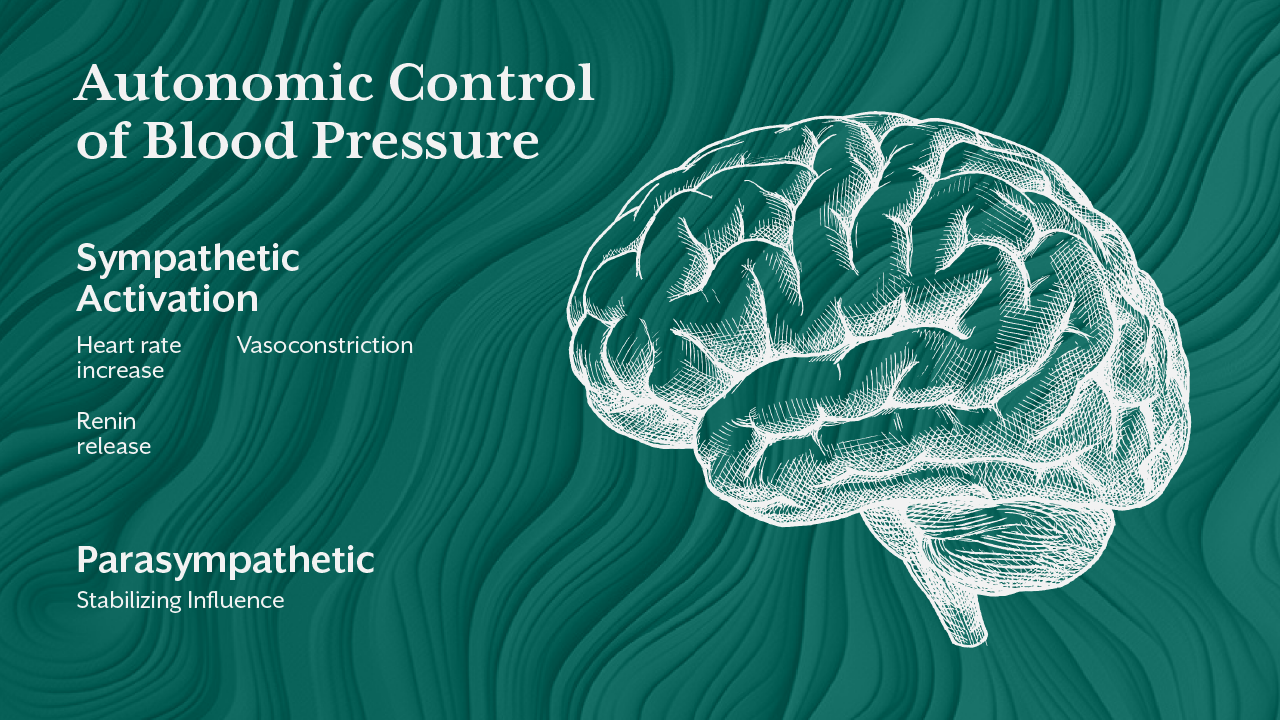
The autonomic nervous system plays a dominant role in blood pressure regulation.
Sympathetic activation causes:
- Vasoconstriction
- Increased heart rate
- Increased cardiac contractility
- Renin release
- Sodium retention
When sympathetic activity remains chronically elevated, the pressure regulation shifts upward.
This is extremely common in modern metabolic environments.
Obesity amplifies this process through:
- Adipose-driven inflammatory signaling
- Increased leptin signaling to hypothalamus
- Mechanical vascular load
- Insulin-mediated sodium retention
So hypertension is not just vascular, rather it is neuro-metabolic.
This integration is rarely emphasised in traditional teaching, yet it is central to long-term disease progression.
Why Hypertension Is a Regulatory Disorder - Not Just a Cardiovascular One
One of the most important clinical insights is that hypertension rarely originates in the blood vessels themselves.
Instead, it emerges from multi-system regulatory strain.
Consider three interacting systems:
Neural regulation
Autonomic tone determines moment-to-moment vascular resistance.
Renal regulation
Kidneys determine long-term pressure set-point through sodium and fluid balance.
Metabolic regulation
Energy availability and inflammation influence vascular function.
When all three are stressed simultaneously pressure rises chronically.
This is why hypertension is strongly linked with obesity.
Excess adiposity is not just stored energy. It is endocrine tissue that alters:
- Vascular stiffness
- Sympathetic signalling
- Insulin sensitivity
- Inflammatory tone
Over time, vascular structure remodels making high pressure mechanically easier to sustain.
Hypertension becomes self-reinforcing.
This system's perspective aligns strongly with the approach discussed in the iThrive Academy blog “Normal Cholesterol, High Risk: The Hidden Lipid Markers That Truly Predict Heart Disease”, which explains how cardiometabolic risk is often hidden beneath normal surface measurements.
Both conditions demonstrate a key principle: normal numbers do not always reflect normal physiology.
Hypertension Classification - Why Categories Matter Clinically
Hypertension classification is not just diagnostic labeling.
It helps identify mechanism, risk trajectory, and intervention strategy.
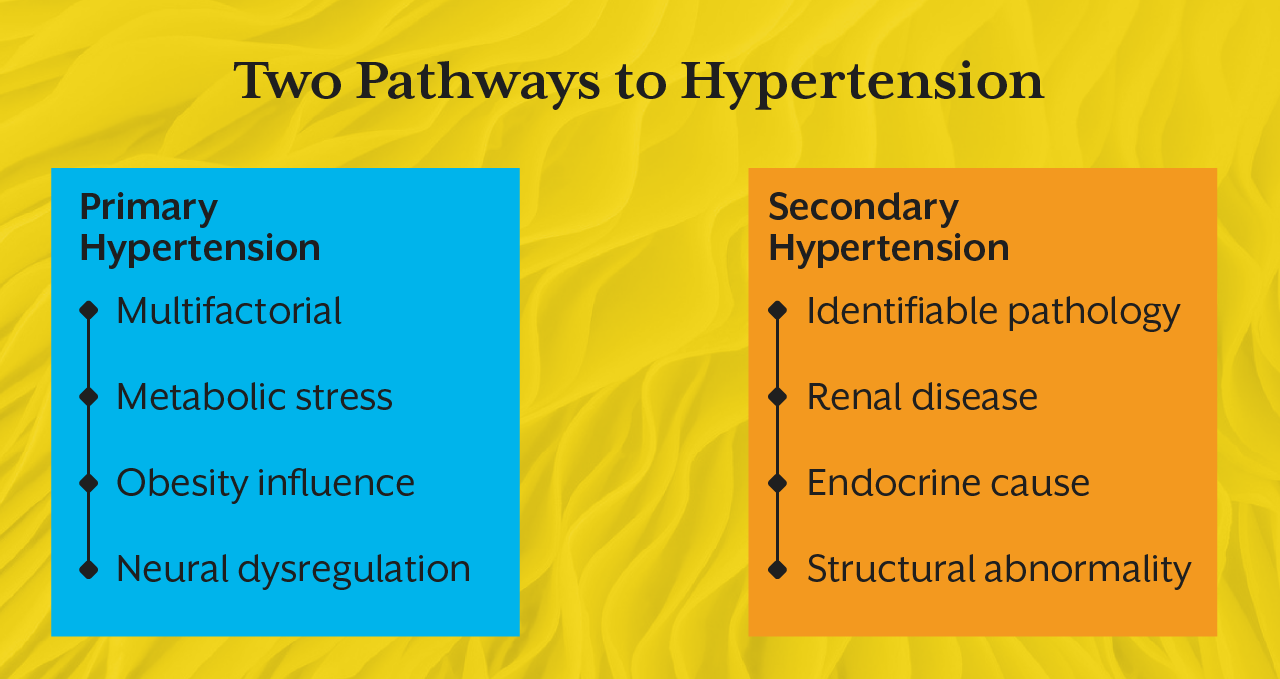
Primary (Essential) Hypertension
Accounts for most cases.
No single identifiable cause.
Results from combined genetic, metabolic, neural, and environmental influences.
This is where obesity, lifestyle patterns, and autonomic imbalance dominate.
Secondary Hypertension
Occurs due to identifiable pathology, such as:
- Renal disease
- Endocrine disorders
- Vascular abnormalities
Here, hypertension is a symptom, and not the primary disorder.
Distinguishing between these categories is critical.
Treating pressure without identifying origin may delay true intervention.
Section 5: Clinical Blood Pressure Staging - Measurement - Based Classification
From a diagnostic standpoint, hypertension classification also involves pressure thresholds.
Blood pressure is expressed as:
Systolic pressure / Diastolic pressure
These represent:
- Arterial pressure during cardiac contraction
- Arterial pressure during cardiac relaxation
Persistent elevation beyond defined ranges indicates stage progression.
What is often overlooked is that staging reflects risk probability, not structural damage alone.
A person can have early-stage hypertension with significant autonomic dysfunction long before organ injury appears.
This reinforces why early detection must consider physiology, and not just numbers.
Section 6: Obesity, Metabolism, and Pressure - The Overlapping Epidemics
Modern hypertension cannot be understood without addressing obesity.
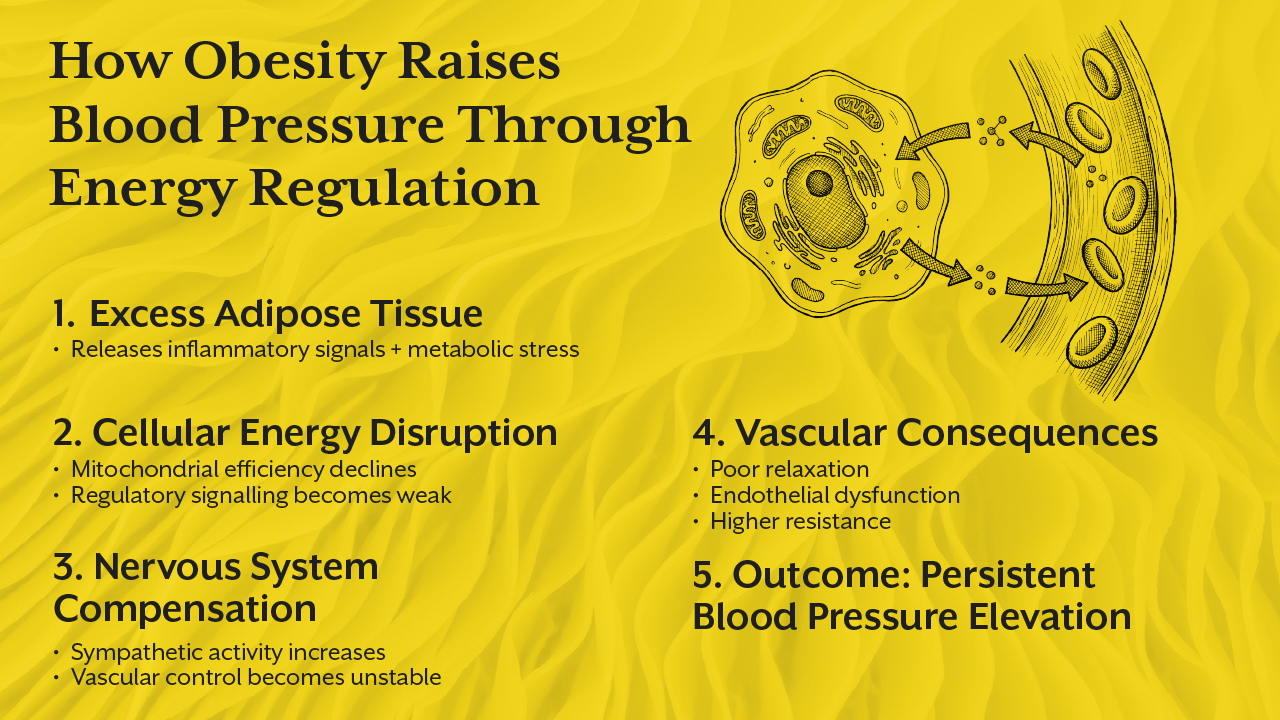
Excess adipose tissue drives pressure elevation through multiple pathways:
- Increased blood volume
- Insulin-mediated sodium retention
- Chronic low-grade inflammation
- Sympathetic activation
- Endothelial dysfunction
But the most overlooked factor is energy regulation.
When cellular energy signaling is impaired, vascular control becomes inefficient.
This metabolic-vascular interaction is conceptually similar to performance regulation described in the iThrive Academy blog “Decoding Functional Sports Nutrition: How Electrolytes and HRV Define True Athletic Recovery.”
Both blood pressure regulation and recovery physiology depend heavily on nervous system balance and cellular energy efficiency.
Different systems have the same regulatory principles.
Why Understanding Classification Improves Clinical Decision-Making
For practitioners, classification guides intervention hierarchy.
It helps answer critical questions:
- Is pressure elevation structural or regulatory?
- Is the nervous system overactive?
- Is renal retention dominant?
- Is metabolic inflammation primary?
Without classification clarity, treatment becomes symptom suppression.
With classification clarity, intervention becomes system correction.
This is the level of interpretation expected in functional clinical practice particularly in advanced practitioner training such as the iThrive Certified Functional Nutrition (iCFN) program.
The Future of Hypertension Understanding - Regulation, Not Reaction
Emerging clinical models increasingly view hypertension as a network disorder.
It is influenced by:
- Neural adaptability
- Vascular elasticity
- Metabolic resilience
- Renal responsiveness
Pressure is simply the final readout.
As clinical education evolves, the focus is shifting from pressure reduction to regulatory restoration.
That is the direction modern functional physiology is moving toward and why deeper understanding of hypertension meaning and classification is no longer optional for serious practitioners.
Key Takeaway
Hypertension is not merely elevated blood pressure, it is the chronic resetting of physiological control systems that regulate circulation, fluid balance, neural tone, and metabolic stability. Understanding hypertension definition, meaning, and classification requires moving beyond measurement toward mechanism. When you recognise hypertension as a neuro-metabolic regulatory disorder shaped by obesity, nervous system activation, and renal set-point control, clinical interpretation becomes deeper and more precise. Classification then transforms from diagnostic labeling into a framework for understanding origin, progression, and intervention. For practitioners and learners, this shift, right from pressure numbers to regulatory physiology and it is what defines modern clinical thinking.








.jpg)