Chronic disease now causes 75% of global deaths, and most nutrition education still teaches symptom management, not root-cause reversal. A functional nutrition course in India fills that gap. This guide covers what the course teaches, how long it takes, and how to pick the right one.
What is functional nutrition?
Functional nutrition is a science-based approach that identifies and treats the root causes of disease, and like not just its symptoms. It looks at how body systems interact, reads lab markers against optimal ranges rather than merely "normal" ones, and uses food, supplements, and lifestyle change to correct imbalances at the cellular level.
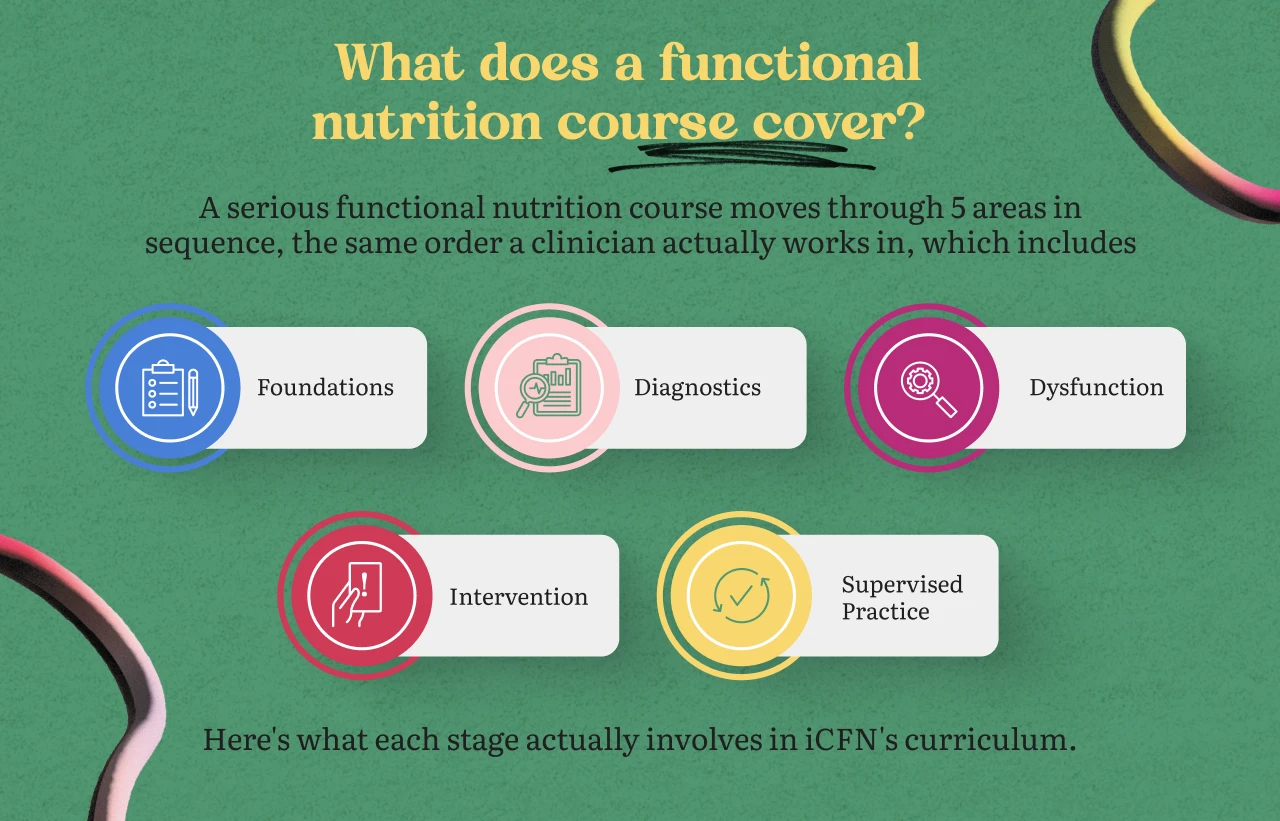
What does a functional nutrition course cover?
A serious functional nutrition course moves through 5 areas in sequence, the same order a clinician actually works in, which includes foundations, diagnostics, dysfunction, intervention, and supervised practice. Here's what each stage actually involves in iCFN's curriculum.
Phase 1: Nutritional foundations
This is where the science underneath every food and supplement recommendation gets built. Functional Nutrients & Dietary Supplements covers macro and micronutrients in clinical depth, plus a practical framework for choosing supplements based on affordability, bioavailability, dose, as well as efficacy. Nutritional Biochemistry & Metabolic Pathways covers the metabolic maps and cellular processes that explain why a nutrient recommendation works, not just that it does.
Phase 2: Diagnostic skills
The flagship module here is Functional Blood Chemistry Analysis, that includes reading CBC, iron, metabolic, inflammatory, and oxidative-stress markers against optimal ranges rather than standard lab "normal" ranges, across 55+ biomarkers at once. This is paired with Gut Health & the GI Map, covering dysbiosis, SIBO, leaky gut, and the gut-organ axes that connect digestive dysfunction to conditions well beyond the gut itself.
Phase 3: Understanding dysfunction
Students go deep into endocrine, cardiovascular, neurological, and autoimmune dysfunction, learning to separate upstream causes from downstream symptoms in multi-system cases. A companion module on Stress, Mental Health & the Nervous System covers the gut-brain axis and stress physiology because chronic stress is very often the hidden driver behind conditions that look purely metabolic on paper.
Phase 4: Intervention design
This is where diagnosis becomes a protocol. Functional Nutrition Therapy teaches condition-specific protocol design step by step for PCOS, diabetes, thyroid disorders, and other chronic conditions, right from assessment through to a finished plan. It's paired with Functional Detoxification that aims at identifying environmental toxin exposure and supporting the body's own clearance pathways, plus modules on EMF/environmental factors and functional movement, so a protocol addresses food, supplements, and lifestyle together rather than food alone.
Phase 5: Capstone and supervised practicum
Case-formulation review carries students into a full month of supervised group practice, where every student formulates real protocols under faculty oversight, one case study every two weeks, with peer review and direct clinician feedback. This is also where consultation skills, client communication, and practice operations get taught, since classroom knowledge alone doesn't prepare anyone to run an actual client consultation.
If a program skips this last step, graduates leave with theory and no practice reps because this is exactly where a lot of nutrition certifications fall short.
iCFN: A 6-month functional nutrition certificate program
Integrative Certification in Functional Nutrition (iCFN) is built and taught by iThrive's own clinical team, which handles 80–100 complex chronic cases every month. The 2026 batch runs across 3 phases over roughly six months:
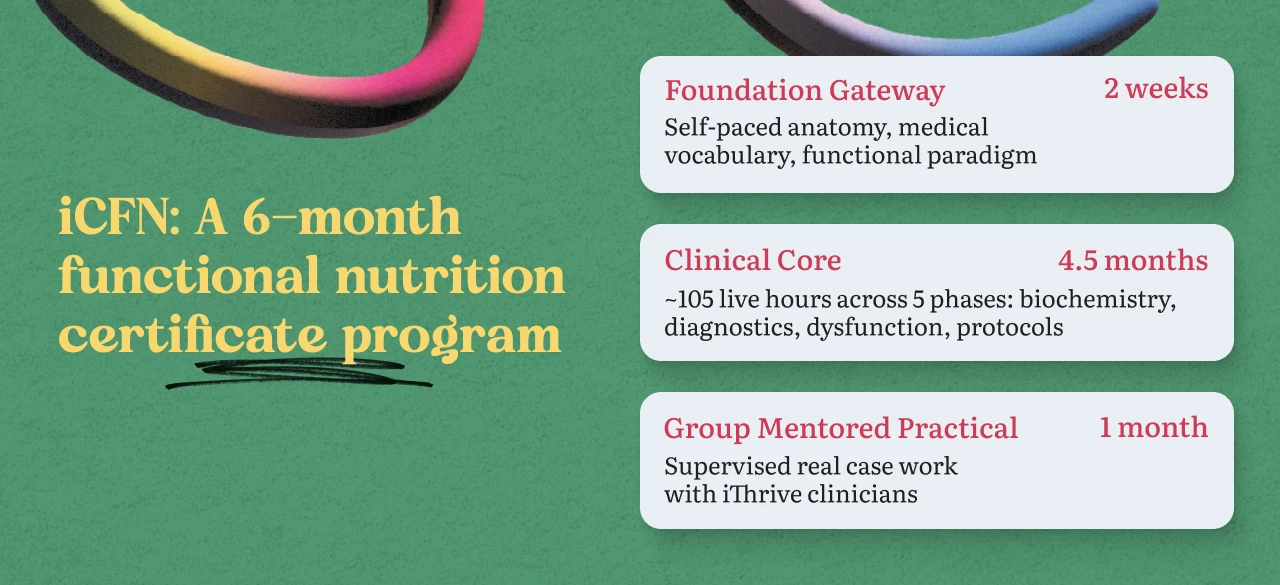
Core clinical modules are taught live on Zoom, not pre-recorded, because the curriculum shifts as faculty's own clinical practice evolves. The program is a Skill India/NSDC partner course recognised by the Government of India, carries AADP recognition internationally, and is delivered by an ISO-certified institution, with 1,000+ practitioners trained across 60 batches.
Who should take a functional nutrition course?
This isn't limited to healthcare professionals. iCFN batches typically include:
- Doctors and dietitians adding root-cause diagnostics and protocol design to an existing practice
- Nutritionists and coaches wanting to work with chronic, multi-system cases instead of general diet plans
- Career-switchers moving into health and wellness from unrelated fields
- Homemakers and caregivers who want to apply the science to their own family's health first
- Former clients of functional nutrition clinics who've experienced the results and want to deliver them to others
Each group follows a slightly different route through the same curriculum, the professionals can test out of the Foundation Gateway, while beginners go through it in full before starting live classes.
How to choose the best functional nutrition course
Before enrolling in any functional nutrition course, check for these four things:
- Live faculty who still practise, don’t mistake this with instructors reading a fixed slide deck year after year
- A supervised practicum, not just recorded lectures and a quiz
- Recognition - government, institutional, or international accreditation
- A structured on-ramp for non-science backgrounds, so nobody falls behind week one
iCFN is built around all four, which is why it's positioned as the best functional nutrition course for career-switchers, healthcare professionals, and homemakers alike.






.jpg)